
Kos Island / Greece
Astypalaia (or Astapalea, not to be mistaken with the island of Astypalaia) was once the capital city of Kos Island in Greece and most likely the birthplace of Hippokrates of Kos around 460 BC, which alone makes it an important piece of the island’s and even the world’s history.
The former city of Astypalaia, which is an area nowadays known to locals as Palatia, has been abandoned after a devastating earthquake around 413/412 BC and a new capital city named Isthmioton/Isthmus has been built in the near of modern day Kefalos. In the years of 366 to 365 BC the capital has been moved to Kos Town that has been gaining importance and remains the capital city of Kos Island to today.
So what you see when visiting this site is a small fraction of the former capital city of Kos and you’re standing in the ruines of a city where people lived, loved, worked or short: Spend their daily life around 2400 years ago.
And if you take a seat on one of the spectator seats of the theatre, you sit at the very same place where people have sit back then and listened to the music and enjoyed the plays and events taking place.
The place itself has a peaceful and tranquil mood which helps the visitor to enjoy the special character of this awesome site.
The Theatre
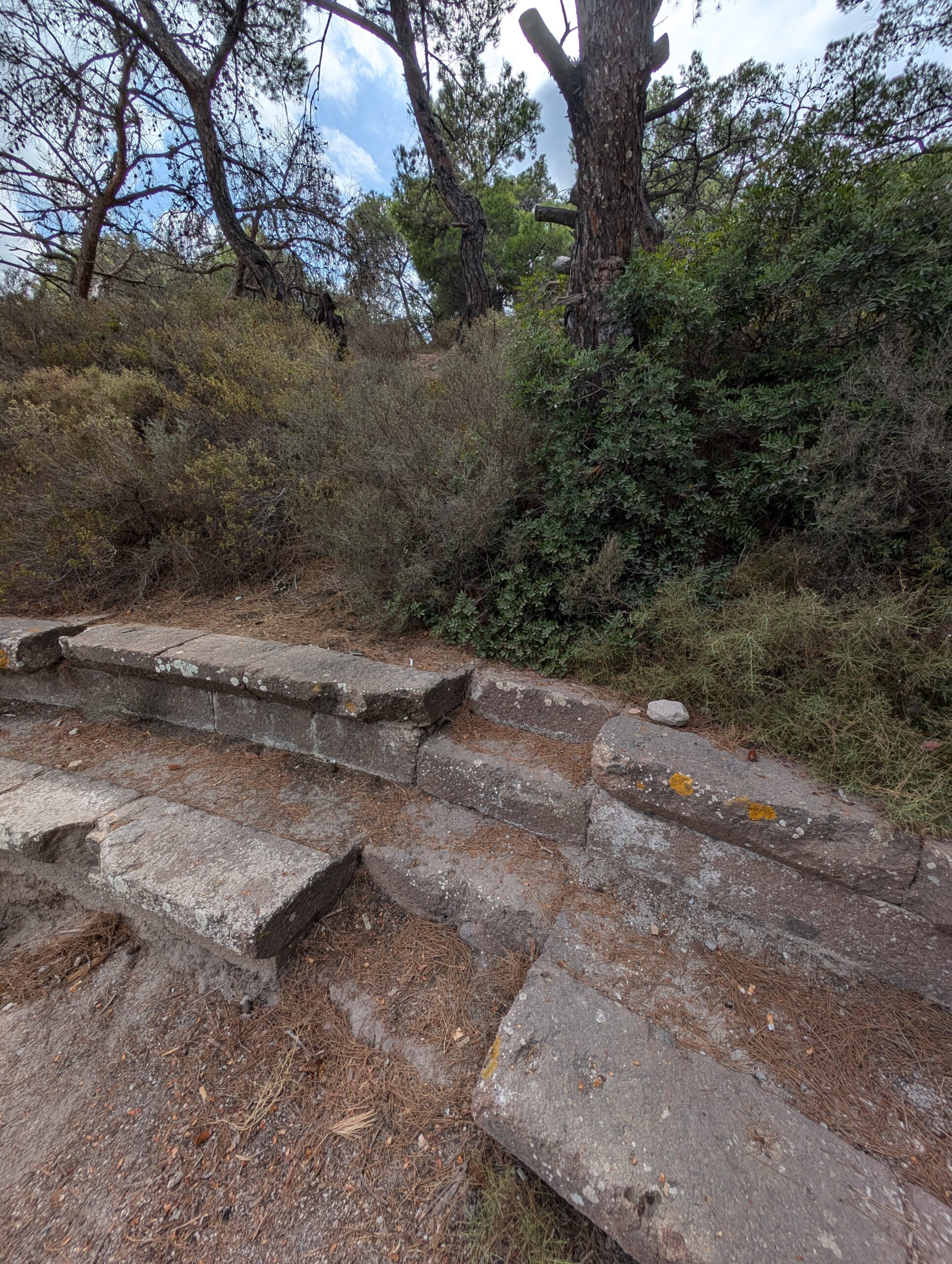
The cavea, which is the term for the seating area of a greek theatre, is based on natural ground of the hill. The theatre most likely was divided into three tiers with most likely (based on the topography) six rows of seats each. From the former 6 rows, only 4 four rows of seats and the altar of Thymele in the center of the first row are left. Most of the seats and the stage building are burried under soil that has been washed down the hill since it’s discovery and excavation in 1928 by the Italian archaeologist Luciano Laurenzi (1902 – 1966, Part of the Italian Archaeological Mission of the Dodecanese 1928 -1938).
The orchestra has a diameter of 12.5 m. The orchestra is the mostly circular space where the chorus danced, sang and interacted with the actors who were on a stage (proscenia) near the skene. The skene, which is the stage building behind the orchestra had the dimensions of 3.25m * 8.5m. The theatre featured an off-stage area for preparations and a proscenia, which is a smaller stage due to the smaller size of this theatre.
Surroundings
The theatre is located approximately 65m from the ruins of the ancient acropolis and a small Doric temple dedicated to Asclepius and Hygieia. More information on this additional area is in preparation and will be added as soon as possible.
Current State
The site is neglected and the last archaeological excavations were last done in/around 1928 to 1930 by the Italian Archaeological Mission of the Dodecanese (1928 -1938). The old photo (soon to come) above shows the state during the excavations back then. I have done a small removal of soil beneath the now visible first row of seats of the cavea and from my standpoint the rows shown on the old photo from 1930 are still there, but rain and time washed soil down the hill and burried the other remains. The now visible structures first have to be cleaned from plants and roots to prevent more damage to the structure. Next step would be to remove the extra soil that gathered there to reach the state it had back in 1930, which definitely should be possible. The site also shows signs of trashing by visitors and remains of a campfire. On the southern side there is a small canyon that seems to slowly claims space in direction of the theater. An old fence that prevents visitors from falling should be also renewed.



Location
SOURCES / REFERENCES
– Laurenzi, Carta archeologica di Coo, Archivio Italiano del τ.α.π.α.
– H.P. Isler, Cos is. Kefala, Teatri Greci e Romani, Roma 1995, 151
– Laurenzi, Nuovi contributi alla topografia storico archeologica di Coo, 625 ff.
– Morricone, Scavi e ricerche a Coo (1935-1943), 328 ff.
CHANGELOG
2024-10-23: Change of image display and addition of current state text
2024-10-17: Addition of current images.
2024-10-17: Addition of theatre description, Sources and GMaps location.
2024-10-16: Adding content.
2024-10-16: Creation of subpage (QRcode-ID 1) for this archaeological site.
Help me to do more…
You like my work and want to support me to do more for this specific site or be able to support more archaeological sites like this?